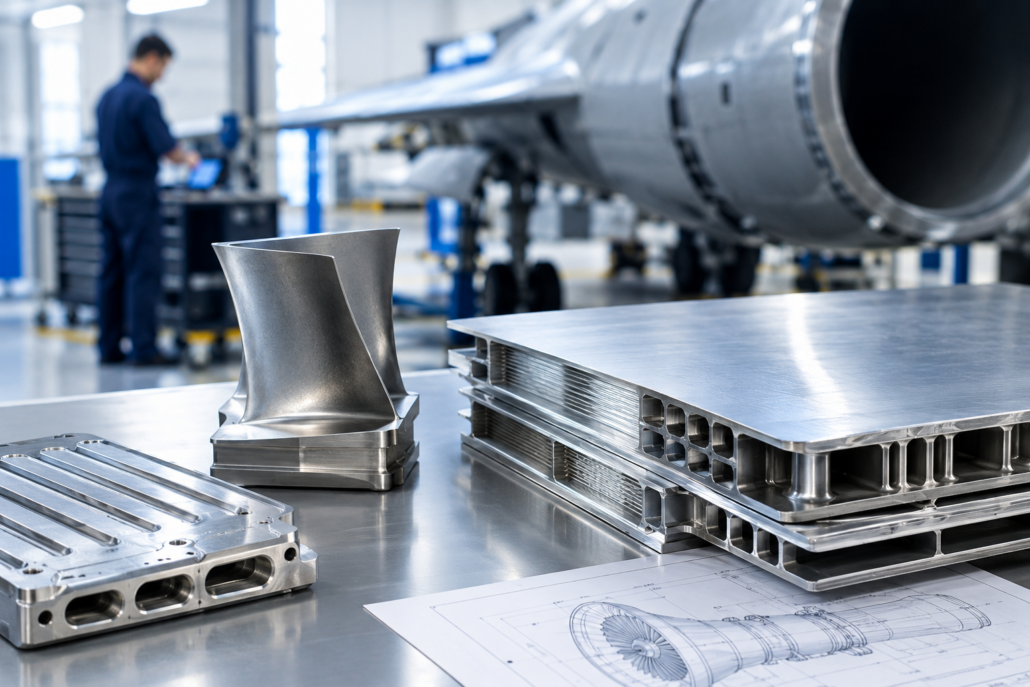
Manufacturers in both aerospace and defense face challenges that few other industries face. The components engineered for these industries must simultaneously be able to withstand extreme temperature, pressure, and thermal cycling.
Components in these industries may also need to be able to withstand the intense vibrations of a rocket launch or high-speed flight, while meeting strict weight constraints and resisting fatigue over repeated operating cycles.
While traditional joining methods like welding and even brazing aren’t inherently bad, manufacturers need to consider how a joint will perform under the intense conditions that these industries demand in the overall design of components.
Diffusion bonding of lightweight structures in the aerospace and defense industries offers a solution capable of creating a highly integrated bond between compatible materials for manufacturers to get the most out of their components.
What Is Diffusion Bonding and How Does the Technique Work?
Diffusion bonding is an advanced solid-state joining technique capable of joining similar and dissimilar materials together at the atomic level, using a combination of heat, pressure, and time.
The diffusion bonding manufacturing process has become increasingly popular within the aerospace and defense industries because of its ability to produce a durable, and often leak-tight, homogeneous joint that retains the strength and integrity of its parent materials.
Unlike fusion welding where the metal is melted at the joint and solidified, or brazing that requires a filler material to be melted, diffusion bonding happens while both parent materials remain solid.
To perform the diffusion bonding technique, the surfaces of the two materials are prepped and meticulously cleaned. The load path is calculated based on the component and its design, and the faying surfaces are brought into intimate contact with one another.
Diffusion bonding takes place at a temperature that is below the parent material’s melting point.
Combined with controlled pressure and time, atomic diffusion occurs, creating a metallurgical bond that produces a highly integrated joint that retains the properties of the parent materials.
Why Is Diffusion Bonding in Aerospace and Defense Components Valuable?
The benefits of diffusion bonding in the aerospace and defense industries come from how the process creates the joint.
When compatible materials are joined together through diffusion bonding under properly controlled conditions, the resulting interface behaves more like a solid block of material, with properties much closer to the parent materials than a conventionally welded or brazed joint. This can be a significant advantage for components that are exposed to intense pressure, temperature, or vibration.
Consider a heat exchanger in a satellite being sent into orbit. During launch, the vibrations, pressure cycling, and changes in temperature that component experiences are tremendous. A diffusion-bonded heat exchanger behaves much more like a single piece of uniform piece of material, with sealed passages for cooling fluids. This combination of structural integrity and leak-tight sealing makes diffusion bonding well suited for thermal management applications.
In addition, diffusion bonding also allows for the creation of lighter, more complex components. Diffusion bonding techniques can combine multiple sheets or components into a single integrated structure, reducing the number of individual parts and fasteners required. The process can also be combined with other techniques, like superplastic forming, to create complex hollow structures that would be difficult to manufacture from a single solid piece.
These benefits don’t mean that diffusion bonding is inherently superior to welding or brazing. Different joining methods each have applications where they are better suited than others. But when a component needs to behave more like a solid piece of material, requires hermetic sealing, has complex internal geometry, or needs to be lightweight, diffusion bonding provides many advantages that make it a valuable option for aerospace and defense applications.
Where Is Diffusion Bonding Used in Aerospace?
Diffusion bonding has a long history in aerospace manufacturing, including early work on lightweight honeycomb and sandwich structures for use in high-performance air and spacecraft. These structures used thin metal sheets and lightweight cores to provide structural rigidity, without the weight of a solid component.
As technologies have advanced, diffusion bonding continues to play an important role in modern aerospace applications in three key areas: thermal management, lightweight structures, and propulsion/engine components.
Thermal Management
Diffusion bonding techniques are essential to the creation of cold plates and microchannel heat exchangers used in the thermal management of spacecraft, satellites, and aircraft. This is an area where VPE excels. Instead of machining a component from a massive block or assembling individual pieces, we are able to build heat exchanger and cold plates from multiple thin sheets that carry multifluid, multichannel flow paths for managing heat in aerospace applications.
Lightweight Structures
One important application of diffusion bonding is the production of lightweight structures in aerospace manufacturing. The process is often used to join thin sheets into sandwich-like structures containing internal cores, channels, and honeycomb-like geometries. One diffusion bonding technique in particular, superplastic forming/diffusion bonding (SPF/DB), carries on the legacy of those early honeycomb panels. SPF/DB is a modern process used to produce complex hollow structures, while also reducing the number of components and fasteners required for space and aircraft applications.
Engine Components
Engineers use diffusion bonding, often in combination with superplastic forming, to manufacture hollow fan blades and other airfoil structures for aircraft engines. Rather than machine a blade from a solid piece, a hollow internal structure can be created from SPF/DB techniques that provide the necessary aerodynamic shape and strength, while reducing weight. Reducing the mass of rotating engine components can contribute to improvements in the overall performance of an aircraft engine.
Diffusion Bonding In the Defense Industry
Much like aerospace, the diffusion bonding in the defense industry also has a long history, particularly with the development of lightweight titanium structures.
Defense applications consistently require low weight, high strength, and fatigue resistant components, as well as the ability to withstand vibration and high thermal loads. These characteristics make diffusion bonding a compelling option for certain defense applications where weight, part consolidation, and environmental durability are important.
The US Air Force, US Navy, and NASA have used techniques like SPF/DB to create diffusion-bonded titanium structures for components in military aircraft, such as the F-15E. Official NASA reports that the usage of SPF/DB titanium in the aft fuselage of the F-15E resulted in 726 fewer components and 10,000 fewer fasteners, while achieving a 15% weight savings compared with previous F-15C/D models.
When engineers and manufacturers in the defense industry deliberately incorporate diffusion bonding techniques into the structural design of their products, rather than simply treating the joining process as an afterthought, they can reduce weight and part count, while building components that can withstand the most demanding performance conditions.
What Factors Should Engineers Consider Before Choosing Diffusion Bonding?
When taken into consideration from the beginning, the diffusion bonding manufacturing process offers significant advantages for aerospace and defense applications. However, that doesn’t always make it the best choice for every single application. Before choosing diffusion bonding techniques, engineers should consider the materials, geometry, operating conditions, and manufacturing requirements.
Engineers should consider material compatibility first. Diffusion bonding is capable of joining similar materials, and in some cases dissimilar materials. However, using diffusion bonding to join different materials can introduce different challenges. That is because different materials have fundamental differences in thermal expansion, diffusion rates, and chemical composition that can create brittle intermetallic layers or voids at the bond surface. An interlayer might be needed to produce a reliable joint.
Surface preparation is another major consideration. Faying surfaces must be exceptionally clean and appropriately prepared. The component also needs to be designed so that bonding pressure can be transferred evenly through the joint area. An unfavorable load path or a contaminated surface can lead to an incomplete or weakened bond.
Engineers should also consider the possible dimensional changes that can occur during the diffusion bonding process. Because significant heat and pressure are applied over time, microscopic deformation can occur on the surface of the materials, which can produce a measurable change in the component. The amount of deformation depends on the material, component geometry, tooling, temperature, pressure, and time required of the project. These dimensional changes need to be accounted for during the joint design process.
Finally, diffusion bonding requires specialized tooling, including a controlled or vacuum atmosphere. The process can also involve longer processing cycles and specialized tooling when compared to some traditional joining methods.
To achieve the best results, diffusion bonding should be considered early on in the design process. VPE often helps our clients evaluate their joint designs, including material combinations, component geometry, and bonding parameters to ensure that diffusion bonding is the right choice for aerospace and defense industry projects.
VPE: Advanced Metal Joining for Aerospace and Defense Manufacturing
Today’s most advanced applications in aerospace and defense increasingly call for components that are durable, lightweight, and can assist thermal management. Diffusion bonding techniques offer a solution that can create complex internal geometries, hermetically sealed fluid passages, and support lightweight designs.
The diffusion bonding process requires careful consideration of materials, geometries, and bonding parameters. When those factors are considered early on in the design process, diffusion bonding can produce advantages that conventional joining methods cannot match.
Vacuum Process Engineering (VPE) has experience and specialized facilities for diffusion bonding high-performance components including heat exchangers, cold plates. We work with customers to evaluate material combinations, component geometry, tooling, and bonding parameters to develop a process suited to their applications.
To discuss the advantages of diffusion bonding and how the process may be appropriate for your application, contact the team at VPE today.

RECENT BUILDS
Recent News
 How Diffusion Bonding Expands the Design Options for Joining Dissimilar and Reactive MetalsSeptember 9, 2026 - 10:46 am
 The Value of Diffusion Bonding in Aerospace and Defense ManufacturingSeptember 8, 2026 - 2:48 pm
 Understanding the Vacuum Heat Treatment Process: How a Vacuum Furnace WorksSeptember 8, 2026 - 11:23 am

