
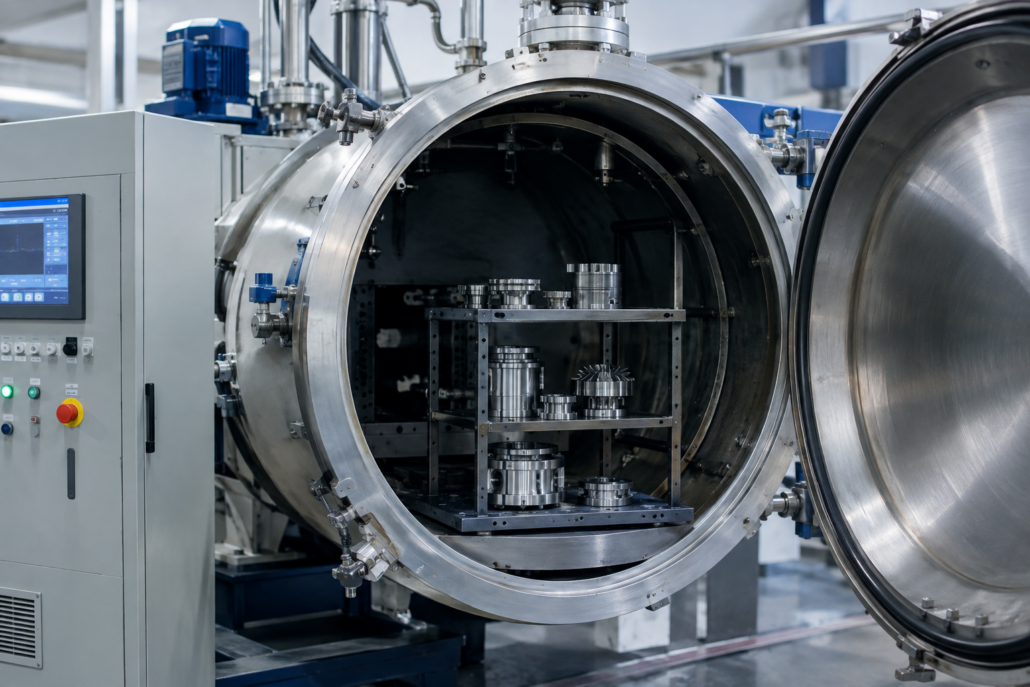
Whether in automotive, aerospace, defense, energy, or other modern applications, manufacturers use heat treatment to deliberately change the properties of a material. Through this process, structural and mechanical parts can be hardened, strengthened, or given other desired properties to help them survive the mechanical stress of their real-world applications.
However, when traditional heat treatment techniques are used working with reactive or sensitive materials, the high temperatures required by the process can increase the potential for unwanted reactions between the material and the surrounding atmosphere. Oxygen, moisture, and other contaminants can affect the material’s surface, potentially undermining the purpose of the heat treatment.
A vacuum furnace can help engineers and manufacturers minimize unwanted interactions, while applying heat treatment to sensitive metals like titanium, molybdenum, or other complex alloys. The vacuum heat treatment process provides a precisely controlled thermal environment for processing these metals.
Understanding how the process works begins with understanding what heat treatment is designed to accomplish, and how a vacuum furnace makes that possible.
What is Vacuum Heat Treatment?
Heat treatment is a foundational process of modern manufacturing. At its core, it is the controlled process of heating and cooling a material to alter its microstructure and physical or mechanical properties.
Depending on the material, heat treatment can be used to achieve a desired result: tt can be used to increase strength or hardness, improve resistance to wear, soften a material to make it more flexible or malleable, improve machinability, relieve internal stress, or create other effects.
Four of the most important variables in a heat-treatment cycle are temperature, time at temperature, heating rate, and cooling rate.
While heat treatment can produce many desirable effects, the issue that engineers often run into is that when sensitive materials are heat treated in ordinary air, the process can expose the surface to reactive gases.
The vacuum heat treatment process offers a solution for treating sensitive materials. It follows the same general principle of heat treatment, but uses the highly controlled, low pressure atmosphere of a vacuum furnace to greatly reduce the amount of atmospheric gases that can create an unwanted reaction in the material.
By reducing the concentration and partial pressure of oxygen, moisture, and other atmospheric gases, the vacuum heat treatment process minimizes the potential for unwanted reactions with the material being treated.
Understanding the Working Principle of a Vacuum Furnace
Heat treatment using a vacuum furnace is about more than just removing air from inside the furnace. The working principle of a vacuum furnace is based on controlling both the thermal cycle and atmosphere surrounding the material. Temperature, time, heating and cooling rates, and vacuum conditions are all fundamental factors controlled during the process.
Regardless of the materials and effects you want to achieve, the vacuum heat treatment process follows these essential steps.
Loading and Sealing
Start by preparing and placing the components inside the vacuum furnace. Depending on the material, parts may need to be fixtured and positioned to achieve the desired thermal uniformity.
Once the materials have been placed, the chamber is sealed.
Evacuating the Chamber
The vacuum pump is initialized, and air is removed from the chamber. A vacuum cannot remove every molecule from the chamber, but the process does dramatically reduce the amount of air and other gases present that could cause contamination.
Controlled Heating
Once the vacuum has removed most of the air, the heating elements gradually raise the temperature to the desired level following a programmed heat cycle. As the vacuum reduces gas pressure inside the furnace chamber, conventional convection is reduced. Instead, heat is transferred primarily through radiation. It’s important to consider the load configuration, temperature control, and the furnace design itself in order to achieve uniform heating.
Soaking at Temperature
As the temperature inside the furnace increases, moisture and other molecules that have accumulated on the furnace and component surfaces can “desorb”, temporarily increasing the chamber pressure. As the system pumps those gases out, the pressure can decrease again. These changes can occur throughout the heating cycle as different materials are released at different temperatures.
When the furnace hits the target temperature, the parts are held for a specific time period. This process is called soaking. The hold allows the load to reach a uniform temperature, while giving enough time for the desired metallurgical changes to occur.
Controlled Cooling
Once the required thermal cycle is completed, a controlled cooling process is used to bring the temperature of the material back down. Some treatment processes, like quenching, require rapid cooling, while others may use a more gradual cooling process. Depending on the process, cooling may occur under a vacuum or by introducing an inert gas or controlled process gas, such as argon or nitrogen. In many vacuum heat treatment processes, cooling is a critical part of achieving the desired properties.
Completion
After the controlled cooling process has been completed, the chamber can be returned to atmospheric pressure and the components removed.
Why Use the Vacuum Heat Treatment Process for Sensitive Materials?
In the context of heat treatment, sensitive materials are those that when exposed to oxygen or atmospheric gasses at elevated temperature can become vulnerable to unwanted reactions or changes in the material’s surface or properties.
At the elevated temperatures required for heat treatment, sensitive materials like titanium, titanium alloys, molybdenum, and other reactive materials face a variety of challenges. One of the biggest is oxidation.
At high enough temperatures, oxygen reacts with sensitive metals, leaving an oxide layer on the surface. Oxidation can be problematic because it can alter the characteristics of the material’s surface. For instance, when a component requires heat treatment before later being welded, brazed, plated, or chemically treated, oxide formations can interfere with those later processes.
Using a vacuum furnace during the heating process solves this problem by removing most of the air inside the furnace prior to and during the heat-treatment cycle. This allows the material to be heated and held at the desired temperature, while minimizing its potential for oxidation.
This is particularly important when working with reactive metals like titanium and molybdenum, both of which react readily to oxygen at elevated temperatures. Closely controlling the atmosphere inside the furnace helps these materials minimize unwanted oxidation and preserve the desired surface condition.
However, it should be noted that the goal of vacuum heat treatment isn’t to universally eliminate oxidation. Some high-performance nickel and cobalt-based alloys can rely on protective oxide layers for oxidation resistance during service. The appropriate processing environment will depend heavily on the materials being used, the desired properties, and what processes the component will undergo after heat treatment.
Successfully Heat Treating Sensitive Materials in a Vacuum Furnace
Different materials will have different atmospheric requirements. Successfully heat-treating sensitive materials like titanium, molybdenum, and other reactive metals requires understanding how the material reacts to oxygen and other atmospheric elements at elevated temperatures, then carefully controlling the processing environment accordingly.
The thermal cycle must also be tailored to the material and desired properties. Temperature, time at temperature, heating, and cooling rate all influence the final result. The furnace’s vacuum level and cleanliness also play an important role. This is especially true when the material is reactive to oxygen or when the surface needs to remain extremely clean for post-processing.
How the parts are configured and loaded within the furnace can also affect how uniformly heat is applied. During the vacuum furnace heating process, gases and vapors are released from surfaces, which can cause changes in chamber pressure. Understanding how these variables change during the cycle is important when developing and validating the process.
It’s also important to consider whether the component will be vacuum brazed, welded, plated, coated, or subjected to other surface treatments after heat treatment. Extra attention may need to be paid to keeping the surface clean during heat treatment.
These considerations make vacuum heat treatment a highly controlled engineering process, rather than a simple heating operation. An experienced and reliable processing partner can help evaluate the material, desired properties, thermal cycle, and atmospheric requirements and help ensure the vacuum heat treatment process is conducted successfully.
VPE: Experienced Partners in the Vacuum Heat Treatment Process
Heat treatment is one of the most powerful tools in modern manufacturing, helping engineers change material properties to fit a project’s needs. When working with sensitive materials like titanium, titanium alloy, molybdenum, and other reactive materials, a vacuum furnace can help minimize undesired reactions during processing.
Doing so successfully requires closely controlling the thermal cycle and atmosphere, not simply reaching an elevated temperature.
Vacuum Process Engineering (VPE) has been helping clients achieve desired effects in sensitive materials using our extensive vacuum furnace capabilities for 50 years. Our team can help you understand the precise combination of materials, thermal cycles, and atmospheric control needed to achieve the properties you need in sensitive materials.
Contact VPE today to learn more about our facilities and how we can assist your next project.

RECENT BUILDS
Recent News
 How Diffusion Bonding Expands the Design Options for Joining Dissimilar and Reactive MetalsSeptember 9, 2026 - 10:46 am
 The Value of Diffusion Bonding in Aerospace and Defense ManufacturingSeptember 8, 2026 - 2:48 pm
 Understanding the Vacuum Heat Treatment Process: How a Vacuum Furnace WorksSeptember 8, 2026 - 11:23 am

