Engineers can spend countless hours selecting the right materials for a critical assembly. They may know that the end component needs to be capable of withstanding high temperatures, providing corrosion resistance, and retaining its strength under demanding operating conditions, but overlook one key decision during the design process: the filler metal for vacuum brazing.
Selecting the wrong filler metal can compromise an otherwise well-designed assembly by creating problems with strength, corrosion resistance, and high-temperature performance.
Choosing the right brazing filler metal depends on the actual use case of the component and the vacuum brazing process itself.
Common Types of Vacuum Brazing Filler Metals
Vacuum brazing can be used to join a wide range of metals and alloys used in industrial applications, but the filler metals must be compatible with both materials being joined, and the brazing process itself.
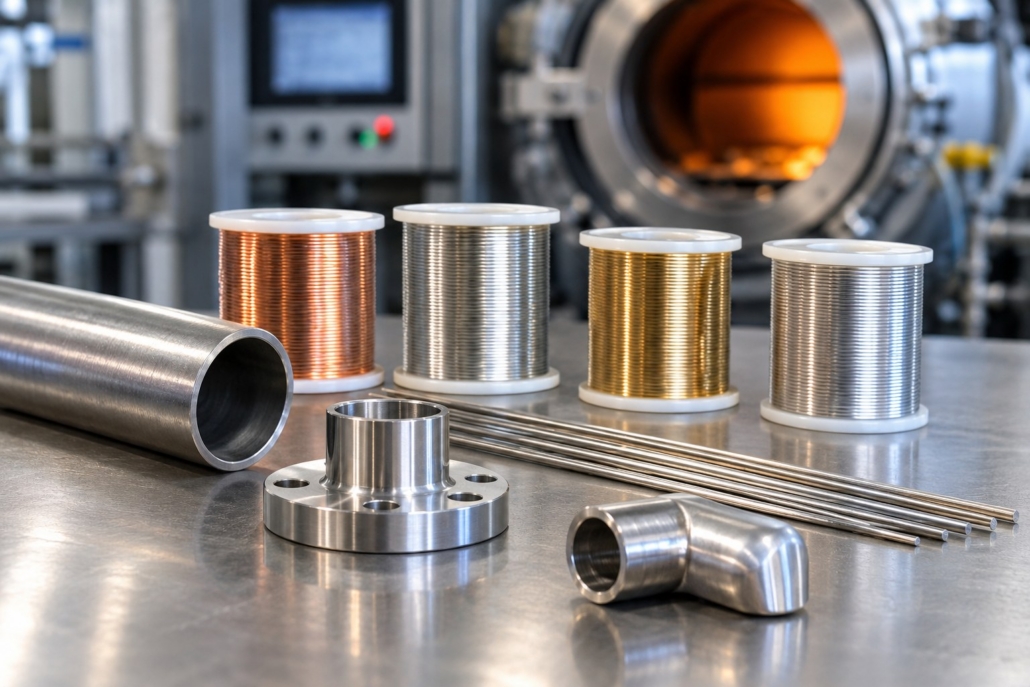
Brazing filler metals are generally classified by their primary metallic constituents. The most common families include nickel, copper, silver, and aluminum-based alloys.
Nickel-Based Brazing Alloys
When working with stainless steel and nickel parent materials, nickel-based brazing alloys are often used as filler metals in applications that require high-temperature performance and corrosion resistance.
Nickel-based brazing alloys can contain elements like boron, silicon, or phosphorus that can lower the alloy’s melting temperature. These are known as melting-point depressants. They make it possible for nickel-based brazing alloys to melt below the melting point of the stainless steel or nickel parent materials.
However, that can have an impact on joint design. Certain elements in nickel-based alloys, such as boron, can cause brittle compounds to form within the joint, especially when the joint clearance is particularly wide. This can weaken the finished joint. Engineers should consider the joint design, filler composition, and brazing temperatures before selecting an alloy.
Copper-Based Brazing Alloys
Copper-based filler metals are commonly used in applications where thermal or electrical conductivity is important. Pure copper is often used as a brazing filler metal, and copper-based alloys can offer different melting temperatures and flow characteristics.
However, the operating environment must also be considered. Copper and stainless steel can form a galvanic couple when exposed to certain electrolytes. When considering brazing with copper, corrosion exposure and joint design need to be evaluated before committing to the pairing.
Silver-Based Brazing Alloys
The relatively low brazing temperature and favorable wetting and flow characteristics of silver make it another common choice for vacuum brazing.
One useful example is brazing a tungsten carbide cutting tip onto a steel body using a silver-based alloy. The silver alloy’s lower brazing temperature can help reduce thermal stress, while many silver-based fillers have the ductility to accommodate differential expansion and mechanical loading.
However, not all silver-based alloys are suitable for vacuum furnace brazing. They can contain elements such as zinc or cadmium which can evaporate under vacuum, which can potentially change the filler composition or contaminate the furnace.
Aluminum-Based Brazing Alloys
Aluminum can be particularly challenging to braze because many aluminum brazing filler metals melt at temperatures relatively close to those of the melting range of the aluminum base material. If the temperature is too low, the filler may not flow well. If it’s too high, the aluminum base materials can potentially melt or become distorted.
In addition, aluminum’s affinity for oxygen means it can quickly form an oxide layer that can inhibit wetting of the molten filler metal. Successfully vacuum brazing aluminum requires careful process control including material selection, cleanliness, and oxide management.
Key Factors to Consider When Choosing a Brazing Filler Metal
Several key factors determine whether a filler metal is suitable for a particular vacuum brazing application.
1. Compatibility With Parent Materials
Not all filler metals are ideal for vacuum brazing. The first consideration should be how the filler wets and bonds with the parent materials being joined. Choosing the wrong filler can create brittle phases, corrosion risks, or other unacceptable reactions that can jeopardize the integrity of the joint. Choosing an alloy from a similar family is a good starting point, but the alloy must still be evaluated for compatibility with the parent materials.
2. Brazing and Operating Temperatures
The braze alloy should be able to melt and flow into the joint at a temperature that doesn’t cause the parent materials themselves to melt or become distorted. The completed joint should also be able to retain its strength and stability at the component’s intended operating temperature. A higher melting point for the filler material doesn’t necessarily mean the joint itself will have better high-temperature performance.
3. Mechanical and Environmental Requirements
Each component will have its own mechanical requirements such as joint loads, pressure, thermal cycling, and corrosion resistance, which will impact which alloy will perform best. For example, medical applications may need to be biocompatible, which can influence the choice of filler metal.
4. Joint Design and Clearance
The actual design of the joint can influence which filler alloys are most suitable. Joint clearance must be carefully controlled to allow for capillary flow and filler distribution. Clearances that are too wide or too narrow can create issues with filler distribution and potentially compromise the joint quality.
5. Vacuum Furnace Compatibility
Some filler alloy compositions can contain elements that can evaporate under the temperatures in the vacuum furnace and potentially cause contamination. The alloy selected should be compatible with furnace atmosphere, vacuum level, and thermal cycle.
Keep in mind that an alloy’s suitability for the manufacturing process and its suitability for the finished component are two different questions.
An alloy can have the right properties for the final component, but be unsuitable for the vacuum brazing process because of potentially volatile constituents. These factors both need to be considered during the joint design phase to ensure that the right braze alloy is chosen for your application.
Why Filler Metal Selection Should Begin During the Design Process
Imagine this scenario: your team has been working for months on a joint design for a stainless steel heat exchanger that will ultimately need to be vacuum brazed. The finished joint must simultaneously operate under high temperatures and handle potentially corrosive fluids.
During the design process, an engineer specifies a filler metal that can successfully join stainless steel, but may not provide the corrosion resistance needed for the heat exchanger’s operating conditions.
The brazing process is ready to begin, but the braze manufacturer notices that the alloy selected is unlikely to meet the end components requirements for corrosion resistance. Because the alloy has been specified on the engineering drawing, changing it requires approval from the manufacturer.
Discovering a problem with a specified braze alloy just before production can lead to engineering revisions, addition testing, and costly delays. Worse yet, if the problem goes unnoticed, it can create a joint that ultimately fails under real world conditions.
Consulting a vacuum brazing specialist early in the design process can help manufacturers avoid these problems. A brazing specialist can help you evaluate the compatibility of vacuum brazing filler metals with your project, its joint design, and operating requirements before the project’s drawings are finalized.
Early involvement of a brazing specialist can also give you an opportunity to develop and test a limited run of components which can help you evaluate a component’s performance before moving into full production.
Let VPE Help You Choose Vacuum Brazing Filler Metals With Confidence
If your organization is designing an assembly that requires vacuum brazing, VPE can help you evaluate your options for filler metals based on material compatibility, joint design, and operating conditions.
Contact VPE during the design phase to discuss your application with our vacuum brazing specialists before finalizing your production plans.

RECENT BUILDS
Recent News
 How to Choose the Right Vacuum Brazing Filler Metal for Your ApplicationNovember 4, 2026 - 8:14 am
 How Diffusion Bonding Expands the Design Options for Joining Dissimilar and Reactive MetalsSeptember 9, 2026 - 10:46 am
 The Value of Diffusion Bonding in Aerospace and Defense ManufacturingSeptember 8, 2026 - 2:48 pm
